



Home › ATO Debt Collection
ATO Debt Collection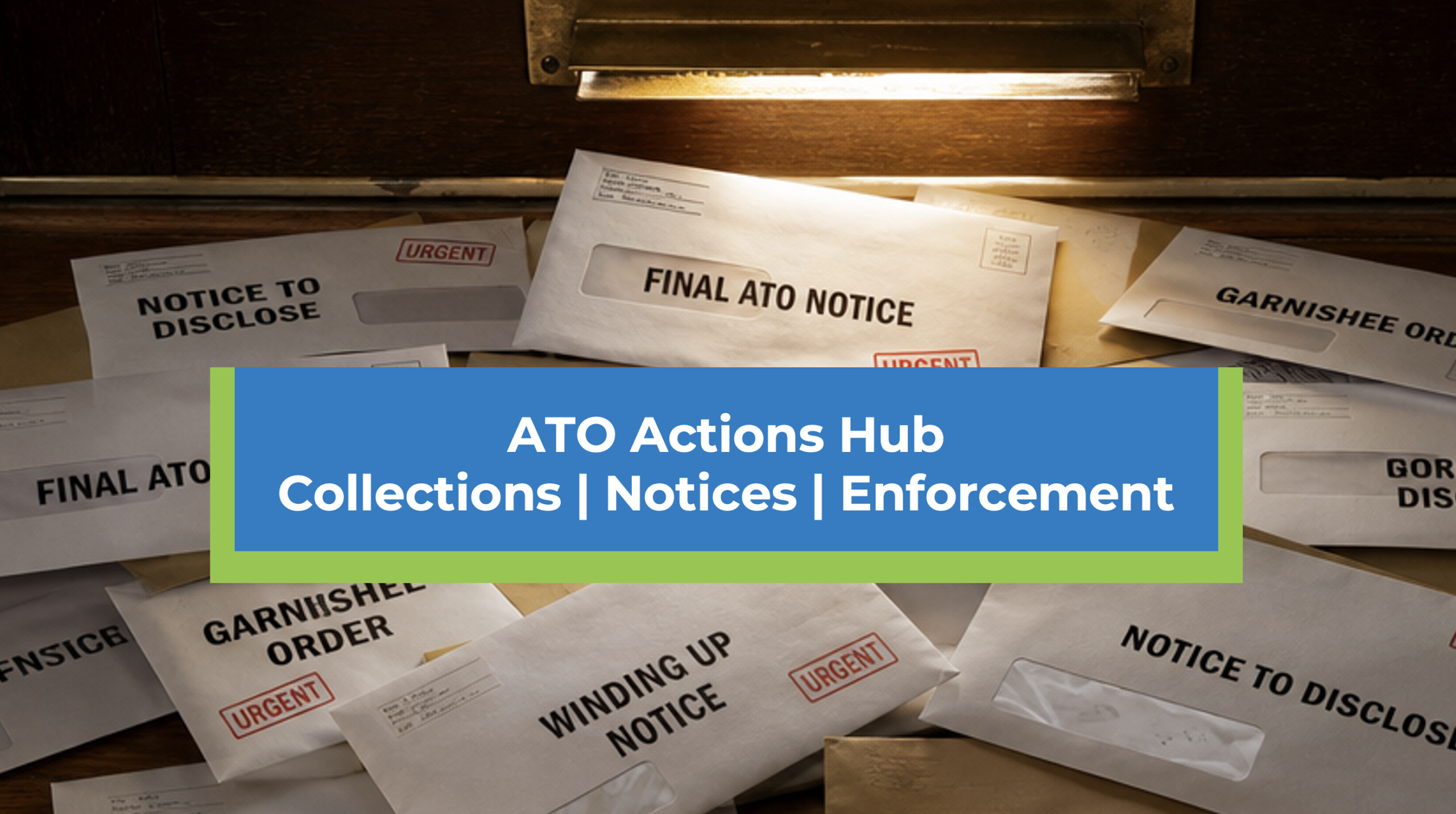
ATO debt collection actions: what each notice means and how long you have
The ATO has moved out of its post-pandemic leniency period and back into firm enforcement. Directors are not usually dealing with one notice. They are dealing with a sequence.
Two of them give you no warning at all. The single most useful thing you can do right now is work out exactly which notice you are holding and how many days it leaves you.
Not sure what you have received?
Send it to us and we will tell you what it means and what happens next.How long each ATO notice gives you
| Notice | Time you have | If you do nothing | Can it be reversed? |
|---|---|---|---|
| Lockdown DPN | Liability already applies | The ATO recovers the company tax debt from you personally | Only by payment of the underlying liability |
| Non-lockdown DPN | 21 days | Personal liability crystallises on day 22 | Yes, if one of four actions is taken in time |
| Statutory demand | 21 days | The company is presumed insolvent | Only by payment, settlement or a set-aside application inside the 21 days |
| Garnishee notice | None, already in effect | Funds are redirected from your bank, customers or merchant facility until the debt is paid | Rarely, once funds are paid over |
| Winding up application | Until the hearing date | A liquidator is appointed and the business ends | By dismissal, adjournment or a formal restructure |
| Intent to disclose notice | 28 days | A tax default appears on the company credit file | Yes, by payment or genuine engagement with the ATO |
| Departure prohibition order | None, and no expiry date | You cannot leave Australia until the ATO revokes it | Yes, once the liability is discharged |
Three of these give you no time at all. A garnishee is already operating by the time you hear about it, a departure prohibition order takes effect the moment it is issued, and a lockdown DPN makes you personally liable straight away. That is why the notices that do give you a deadline are worth acting on immediately, because they are the last stage at which the outcome is still in your hands.
Every one of these has a deadline that cannot be extended.
The earlier we are involved, the more options remain open.What each ATO notice actually means
Director Penalty Notice
Makes you personally liable for the company’s unpaid PAYG withholding, GST and superannuation guarantee charge. Posted to your home address as it appears on the ASIC register, and the 21-day clock starts on the date of the notice rather than the date you open it. A non-lockdown notice can still be remitted if you take one of four actions in time. A lockdown notice, issued where the company failed to lodge, cannot.
Winding up notice and statutory demand
Requires payment within 21 days of service. Miss it and your company is presumed insolvent, which lets the ATO apply to the court to have a liquidator appointed without having to prove insolvency. Applications are advertised publicly, so banks, insurers and suppliers find out quickly. A restructure can still support an adjournment, but the evidence has to be prepared before the hearing.
Garnishee notice
Requires a third party who holds or owes you money to pay the ATO instead. No court order is needed. It can be served on your bank, your customers, your merchant facility provider or your invoice financier, and an enduring notice keeps taking a percentage of everything that comes in. The first sign is usually a failed payroll run.
ATO credit reporting
Where a business has at least $100,000 in tax debt overdue by more than 90 days and is not engaging with the ATO, the debt can be reported to credit reporting bureaus. It then shows as a tax default on the commercial credit file that every lender, insurer and supplier checks. You get a formal intent to disclose notice giving you 28 days to act first.
Departure prohibition order
Prevents you personally from leaving Australia until your tax liability is dealt with. No court order is required, it takes effect the moment it is issued rather than when you receive it, and it has no expiry date. Directors most often encounter one after a Director Penalty Notice has already made them personally liable.
Which notices arrive together
These actions are not alternatives. They are stages, and they overlap. A typical escalation looks like this.
Reminders and warning letters
The cheapest point to fix the problem, and the one most often ignored.
A payment arrangement, then a default
A broken arrangement is the single most common trigger for everything that follows.
Credit reporting and Director Penalty Notices
The debt becomes public and becomes personal at roughly the same stage.
Garnishee notices and departure prohibition orders
The ATO stops asking and starts taking, without a court order.
Statutory demand, then a winding up application
The company’s continued existence is now in the hands of a court.
Solving one notice in isolation rarely works, because the underlying position has not changed. If the business cannot service the debt, dealing with the debt itself is the only thing that stops the sequence.
Received more than one of these?
That is the normal pattern, and it is exactly what we deal with.Where a Small Business Restructure fits
A Small Business Restructure is a government-legislated process under the Corporations Act. You appoint a registered Small Business Restructuring Practitioner, you keep control of the company, and you keep trading while a plan is put to creditors to pay a portion of the admissible debt over a defined period. Once the practitioner is appointed, affected creditors including the ATO cannot start or continue recovery action without the practitioner’s consent or the court’s approval. The process runs to a legislated timetable of roughly 35 business days.
To be eligible for an SBR, a company generally needs
 Total liabilities under $1 million, excluding employee entitlements
- Tax lodgements up to date, which can be brought current before appointment
- No restructuring or simplified liquidation by the company or its directors in the past seven years
- Not already in liquidation or voluntary administration
Timing decides how much a restructure can do
Appointed while a DPN clock is still running, it remits the director penalty. Appointed after a winding up application is filed, it becomes an argument you have to put to a court. Appointed after a garnishee has issued, it stops new recovery action but does not automatically remove the notice already in place.
Find out where you stand
Check whether your company is eligible for a restructure in 60 seconds, or call for a confidential conversation about the notice in front of you.
Check your eligibility Call 1300 947 465Reviewed by Thomas Dawson, Registered Liquidator, Small Business Restructuring Specialists. Last reviewed September 2026. This page is general information only and does not take your circumstances into account. Liability limited by a scheme approved under Professional Standards Legislation.