



Home › ATO Debt Collection › Garnishee Notice
ATO Debt Collection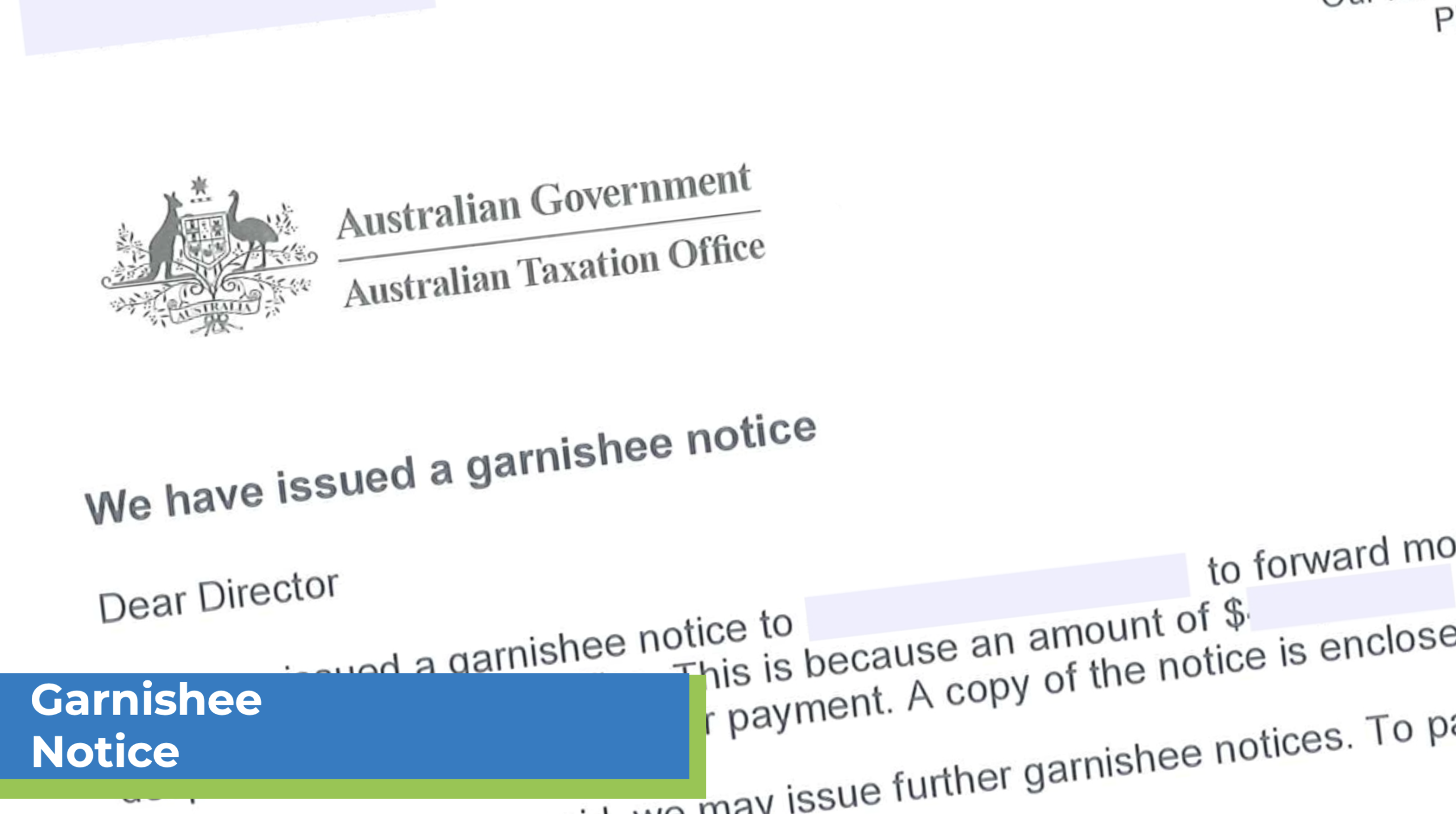
The ATO is taking money before it reaches you
A garnishee notice orders your bank, your customers or your card provider to pay the ATO instead of you. No court order is required, and the third party is legally obliged to comply.
Most ATO actions give you a deadline. A garnishee does not. Most ATO collection actions give you a deadline. A garnishee does not. By the time you know about it, the money is usually already gone from the company’s bank account, and the first sign is often a bounced payroll run or a supplier payment that fails.
Send us the notice and we will tell you where you stand today.
Free, confidential, and no obligation.What you can actually do about a garnishee
Be realistic. Once funds have been paid over, getting them back is very difficult. The objectives are to stop the bleeding and fix the underlying position.
Establish exactly what has been issued
Contact the ATO and get the detail: who received notices, one-off or enduring, what percentage, and what the total debt is. You cannot plan around a notice you have not read.
Ask for the notice to be withdrawn or varied
The ATO can do both. Requests succeed only when supported by current lodgements, financials, cash flow forecasts, and evidence of the effect on employees.
Deal with the underlying debt formally
A proposal that gives the ATO a better return than shutting the business down is the argument that works. This is where a restructuring proposal changes the conversation.
Protect wages and critical suppliers
Work out this week whether payroll can be met. If it cannot, that is not a cash flow inconvenience, it is an insolvency issue.
A warning about insolvent trading
If the garnishee means the company cannot pay its debts as they fall due, continuing to trade and incur new debts exposes you personally under section 588G. Get advice rather than trading through and hoping.
Is payroll at risk this week?
Call us today. This is the situation we deal with most often.What to do in the next 48 hours
Send us the notice
You will have been served a copy even though the notice went to the third party. It tells us the type, the amount and the recipient.
Talk to your bank or merchant provider
They can confirm what has already been taken and what is scheduled next. That is the information you need to work out whether you can trade this week.
Get lodgements current immediately
Nothing weakens a hardship or variation request faster than outstanding returns, and unlodged periods create separate personal exposure through the director penalty regime.
Map the full ATO position
Garnishee action normally travels with Director Penalty Notices, credit reporting and eventually winding up proceedings. Solving one symptom achieves very little.
Speak to us before the next payment run
If a garnishee is threatening wages or supply, the position needs to be resolved in days, not weeks.
Every day an enduring garnishee runs, the position gets worse.
The sooner we are involved, the more can be negotiated.How a Small Business Restructure relates to a garnishee
An SBR is usually the fastest route to a stable position, but it is important to be precise about what it does.
What it does. Once a Small Business Restructuring Practitioner is appointed, affected creditors including the ATO cannot commence or continue court or other recovery action against the company without the practitioner’s consent or the court’s approval. New enforcement stops. You stay in control and keep trading, and the company puts a plan to creditors to pay a portion of admissible debt over a defined period, within a legislated timetable of about 35 business days.
What it does not automatically do
Where an ATO garnishee notice is already in place at the date the practitioner is appointed, the ATO’s stated position is that it will not generally withdraw the notice, and it continues to operate on the relevant amounts. Withdrawal or variation is then a matter for negotiation, supported by the restructuring proposal.
The practical conclusion is the one that matters most on this page: a garnishee already in place is harder to shift than one that has not been issued yet. If you have had a warning letter, or a payment arrangement is about to default, get advice before the notice issues rather than after.
To be eligible for an SBR, a company generally needs
 Total liabilities under $1 million, excluding employee entitlements
- Tax lodgements up to date, which can be brought current before appointment
- No restructuring or simplified liquidation by the company or its directors in the past seven years
- Not already in liquidation or voluntary administration
Find out in 60 seconds whether your company qualifies.
The earlier we are involved, the more options remain open.What is an ATO garnishee notice?
A garnishee notice is issued by the ATO under section 260-5 of Schedule 1 to the Taxation Administration Act 1953. It requires a third party who holds money for you, or who owes money to you, to pay that money to the Commissioner instead of paying it to you.
Two features make it the ATO’s most disruptive tool. No court order is required, so there is no hearing and no 21-day period to respond. And the third party must comply: a bank or customer that receives a notice is legally required to pay the ATO, is deemed to have been authorised by you to do so, and is indemnified for the payment. A third party that pays you instead can become liable for the amount itself.
Who the ATO can garnishee
Your bank
Any account the company holds, including the main trading account.
Your customers
Trade debtors who owe your business money. They learn directly that the ATO is collecting from their supplier.
Merchant facilities
EFTPOS and card settlement funds, captured before they ever reach your bank.
Invoice financiers and factoring companies, employers where the debtor is an individual including a director personally liable under a DPN, and purchasers or solicitors involved in a property settlement can all be garnisheed too.
The merchant facility garnishee is the one that surprises retail and hospitality operators. Rather than waiting for card takings to land in the bank, the ATO can go a step earlier in the chain and redirect settlement funds as they fall due.
Point in time vs enduring notices
Point in time (one-off)
A single payment, usually from a bank account. It captures whatever is in the account on the day, up to the debt amount or a specified percentage.
If the account is in overdraft there is generally nothing for the bank to pay. A bad week, but survivable.
Enduring (continuous)
The notice keeps operating, capturing a set percentage of each deposit, merchant settlement or each wage payment until the debt is paid or the notice is withdrawn.
Every dollar of revenue arrives short, indefinitely. If the percentage exceeds your gross margin, the business cannot trade its way out.
For individuals, the ATO applies limits including a general cap of around 30 cents in the dollar of after-tax wages, and it is required to consider your circumstances and hardship. Those protections apply to individuals, not to a company’s trading account.
Why the ATO issued one
Garnishees rarely arrive out of the blue. They usually follow unpaid lodged debts, a warning letter or notice of intended legal action, a defaulted payment arrangement, or a period of no engagement.
Two triggers dominate in practice. A broken payment arrangement, after which garnishee action is common and often quick. And the perception that revenue is at risk, for example that other creditors are being paid ahead of the ATO.
The ATO’s own guidance says a warning letter is generally issued before a garnishee. If you have received a letter warning of intended legal action, that letter is your window and it is worth far more than any argument you can make afterwards.
Commonly asked questions
Can the ATO take money from my bank account without telling me?
The ATO issues the notice to the third party and serves you with a copy. In practice the funds often move before you see it. No court order is required.
Can the ATO garnishee my customers?
Yes. Trade debtors, merchant facility providers and invoice financiers can all be garnisheed.
How long does a garnishee notice last?
A point in time notice is a one-off. An enduring notice continues until the debt is paid or the notice is withdrawn or varied.
Can I get garnisheed funds back?
Very rarely once paid. The realistic aim is to stop further deductions. The garnishee is a process enabling the ATO to recover funds which you have lodged as being owed.
Will a payment arrangement stop a garnishee?
It can support a request to withdraw or vary the notice, but the ATO is not obliged to do so, and a defaulted arrangement is often what caused the garnishee.
Does appointing a restructuring practitioner remove an existing garnishee?
No. New recovery action stops, but an existing notice is not generally withdrawn automatically.
Can the ATO garnishee my personal accounts?
Yes, where you are personally liable, most commonly after a Director Penalty Notice has become enforceable against you.
Get advice before it goes further
Small Business Restructuring Specialists is Australia’s leading independent SBR practice. A free eligibility check takes 60 seconds and a confidential call costs nothing.
Check your eligibility Call 1300 947 465Reviewed by Thomas Dawson, Registered Liquidator, Small Business Restructuring Specialists. Last reviewed September 2026. This page is general information only and does not take your circumstances into account. Liability limited by a scheme approved under Professional Standards Legislation.