



Home › ATO Debt Collection › ATO Credit Reporting
ATO Debt Collection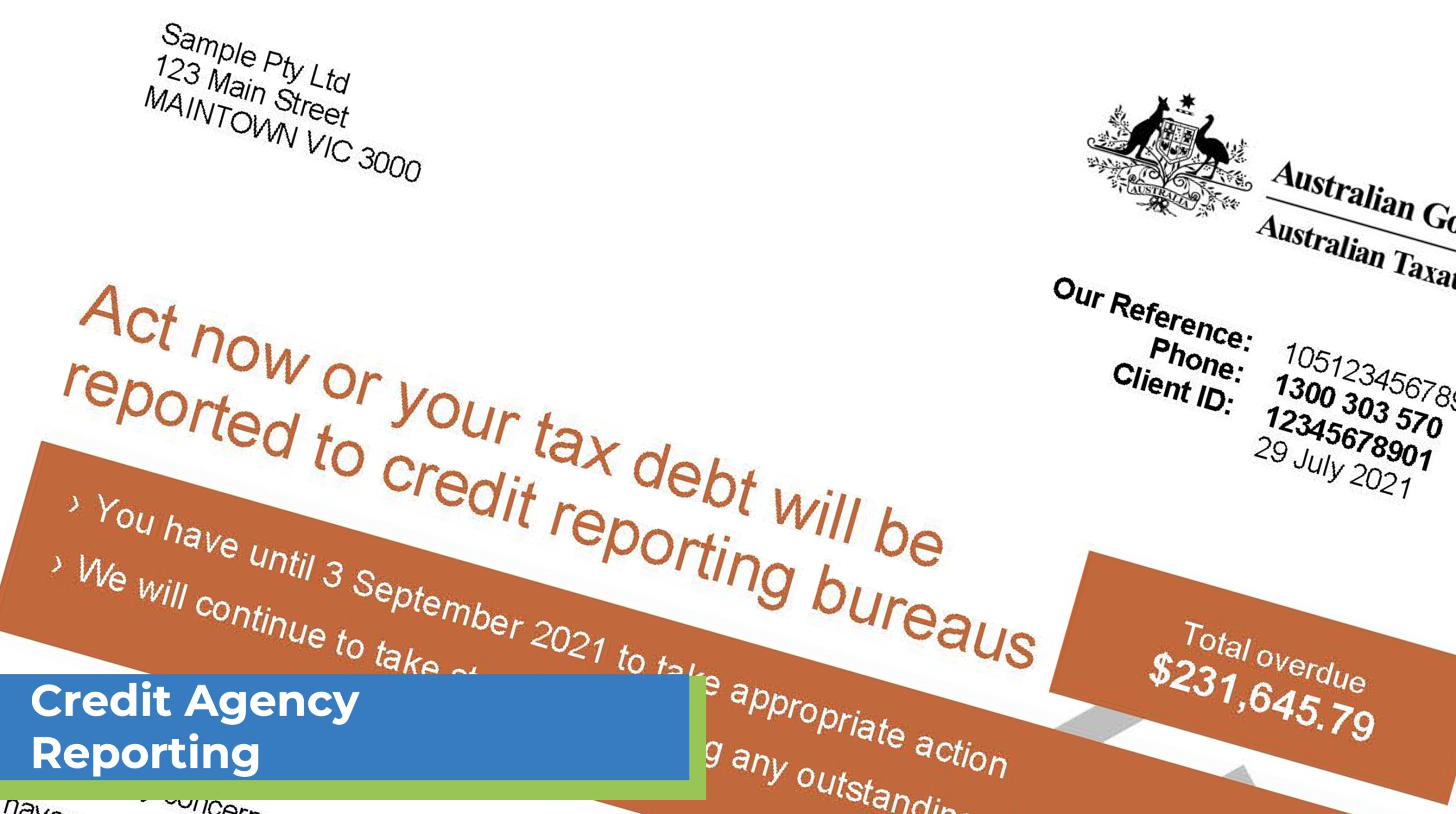
Your tax debt is about to become public
The ATO can report your business tax debt to credit reporting bureaus, where it appears as a tax default on the credit file every lender, insurer and supplier checks.
A tax debt used to be private between you and the ATO. It is no longer private. Once a business debt crosses a defined line, the ATO can report it to credit reporting bureaus, where it appears on the commercial credit file that every bank, equipment financier, insurer and trade supplier pulls before saying yes to anything.
Send us the notice and we will tell you where you stand today.
Free, confidential, and no obligation.What you can do inside the 28 days
Disclosure does not happen without warning. Before reporting anything, the ATO issues a formal Intent to Disclose Notice giving you 28 days to act.
Pay the debt, or bring it below the threshold
Getting the overdue balance under $100,000 removes one of the four criteria and stops disclosure.
Enter a payment arrangement and comply with it
Effective engagement prevents disclosure even where the balance is above the threshold. It has to be an arrangement you can actually service.
Deal with the debt formally
Where the debt is not serviceable, a Small Business Restructure addresses the cause rather than the symptom.
Lodge a complaint with the Tax Ombudsman
An active complaint about the intent to report is itself a bar to disclosure while it is on foot.
Be honest about whether the arrangement is serviceable
A payment plan you will default on in month two buys you eight weeks and then puts you in a worse position, because a defaulted arrangement is evidence of failed engagement. It also commonly triggers garnishee action.
Received an Intent to Disclose Notice?
You have 28 days. Send it to us and we will tell you the options.What to do in the next 48 hours
Find out where you stand
Get a current ATO account balance across all tax types and identify how much is more than 90 days overdue.
Check your own commercial credit file
Do not assume nothing has been reported. Pull the report and see.
Bring lodgements up to date
Unlodged returns undermine any claim of engagement, and they create separate personal exposure under the director penalty regime.
Establish real engagement, in writing
A phone call you cannot evidence is not much use. A documented arrangement is.
If the debt is not serviceable, say so early
The businesses that come out of this well are the ones that stopped pretending the balance was payable and dealt with it.
A tax default follows you long after the debt is dealt with.
Preventing disclosure is far easier than unwinding it.How a Small Business Restructure fits
If your tax debt is over $100,000 and more than 90 days overdue, credit reporting is rarely the only issue. It is a symptom of a debt level the business cannot service, and it usually travels with Director Penalty Notices, garnishee notices and eventually winding up action.
A Small Business Restructure addresses the cause. You appoint a registered practitioner, keep control of the company, keep trading, and put a plan to creditors to pay a portion of the admissible debt over a defined period. Affected creditors including the ATO cannot commence or continue recovery action while the process runs without the practitioner’s consent or the court’s approval.
Two points specific to credit reporting. A restructuring appointment is itself a public event, recorded on ASIC’s published notices, so anyone weighing an SBR against a tax default should understand that both are visible, but only one of them fixes the debt. And the disclosure criteria stop being met once the debt is dealt with under a plan, so a business that emerges with a manageable schedule and current lodgements is in a position to rebuild a credit profile.
To be eligible for an SBR, a company generally needs
 Total liabilities under $1 million, excluding employee entitlements
- Tax lodgements up to date, which can be brought current before appointment
- No restructuring or simplified liquidation by the company or its directors in the past seven years
- Not already in liquidation or voluntary administration
Find out in 60 seconds whether your company qualifies.
Deal with the debt, not just the disclosure.The four criteria for disclosure
All four must be satisfied before the ATO can report anything. Two of them are within your control.
- You have an ABN and are not an excluded entity. Excluded entities are deductible gift recipients, registered charities, government entities and complying superannuation entities.
- At least $100,000 is overdue by more than 90 days. Measured across your total tax debts, not per debt. Recently accrued debt does not count.
- You are not effectively engaging with the ATO. This is the criterion that decides most cases and the only one entirely within your control. A payment arrangement you are complying with is engagement. Ignoring letters is not.
- You do not have an active Tax Ombudsman complaint about the intent to report.
It applies to entity types across the board, not just companies. Sole traders, partnerships and trusts with an ABN can all have a tax default registered.
What a tax default does to your business
The consequences are commercial rather than legal, and they are usually faster than directors expect.
Finance dries up
Applications are declined, and existing facilities can be reviewed, repriced or pulled at renewal.
Trade credit tightens
Suppliers monitoring your ABN receive an alert. Terms shorten and some move you to cash on delivery.
Contracts are affected
Head contractors, franchisors, landlords and procurement teams routinely run credit checks.
Trade credit insurance can also be withdrawn, which quietly removes your suppliers’ ability to extend terms even if they want to. And it compounds: losing supplier terms increases the working capital gap that caused the tax debt in the first place.
Can a tax default be removed?
Yes, but not retrospectively erased in the way people hope. The ATO notifies the bureaus to remove the reported debt once the entity no longer meets the criteria for disclosure, for example when the debt is paid, drops below the threshold, or you enter and comply with a payment arrangement. Bureaus then update the file.
The record of the past default and the period it was reported may still be visible in credit history for some time. Acting turns off the disclosure, but it does not un-ring the bell with a lender who declined you three months ago. Prevention is worth far more than remediation.
Commonly asked questions
What is the ATO credit reporting threshold?
At least $100,000 in tax debt overdue by more than 90 days, plus the other three criteria.
Will the ATO report my debt if I have a payment plan?
Generally no. Effective engagement, including a payment arrangement you are complying with, prevents disclosure even where the balance is above $100,000.
Does ATO credit reporting affect my personal credit file?
The measure targets business tax debt information tied to the ABN and appears on commercial credit reports. Personal exposure comes through a different route, mainly the director penalty regime.
How much notice does the ATO give?
A formal Intent to Disclose Notice giving 28 days to act.
Are sole traders and trusts affected?
Yes. Any entity with an ABN that is not an excluded entity.
How do I get a tax default removed from my credit file?
By no longer meeting the disclosure criteria, through payment, reducing the balance below the threshold, or effective engagement. The ATO then notifies the bureaus.
Get advice before it goes further
Small Business Restructuring Specialists is Australia’s leading independent SBR practice. A free eligibility check takes 60 seconds and a confidential call costs nothing.
Check your eligibility Call 1300 947 465Reviewed by Thomas Dawson, Registered Liquidator, Small Business Restructuring Specialists. Last reviewed September 2026. This page is general information only and does not take your circumstances into account. Liability limited by a scheme approved under Professional Standards Legislation.