


Home › ATO Debt Collection › Winding Up Notice
ATO Debt Collection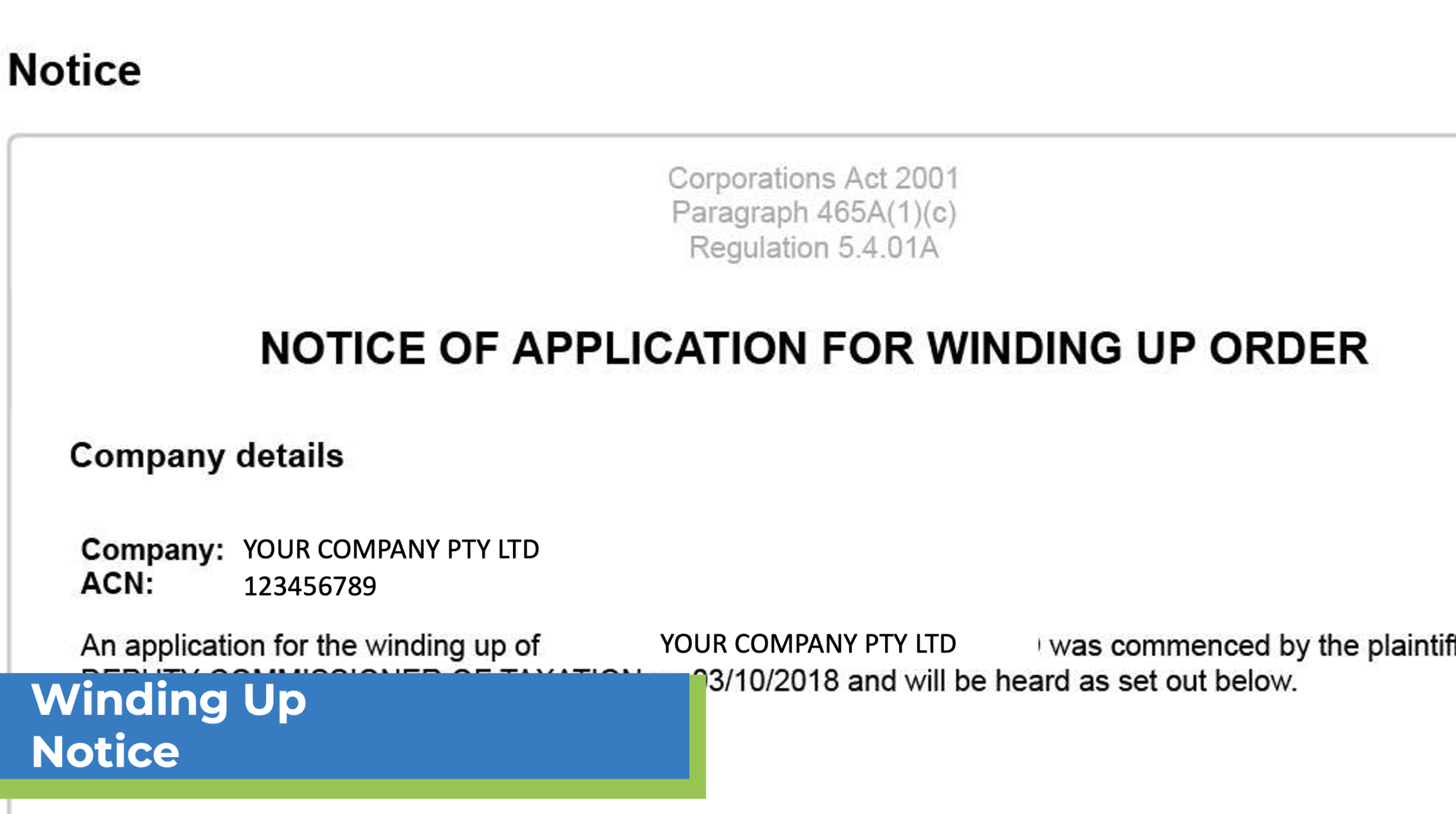
The ATO is applying to shut your company down
A statutory demand is the step before a court appoints a liquidator. Miss the deadline and your company is presumed insolvent, and the ATO no longer has to prove it.
There are no extensions and no dispensations, no matter how good the reason. On day 22 the presumption of insolvency applies.
Send us the notice and we will tell you where you stand today.
Free, confidential, and no obligation.The three things that can satisfy a statutory demand
From the date of service you have 21 days to do one of the following. Courts apply this deadline strictly, with no extensions available for any reason.
Pay the debt in full
The company pays, or otherwise satisfies the demand. This is the cleanest outcome and the only one that removes the risk entirely.
Reach a settlement the ATO accepts
A negotiated outcome the Commissioner treats as compliance. This is where a formal Small Business Restructure proposal carries far more weight than a phone call.
Apply to set the demand aside
Under section 459G, filed with the court AND served on the ATO within the 21 days. Both steps must happen inside the window.
What happens on day 22
If none of the three has occurred, your company is presumed insolvent under section 459C. The ATO can then apply to wind it up without having to prove insolvency, and can rely on that presumption for three months. Continuing to trade and incur new debts from this point also exposes you personally to insolvent trading liability under section 588G.
A statutory demand is not a letter you can leave until next week.
Send it to us today and we will tell you what can still be done.What to do in the next 48 hours
Identify the document and the exact date of service
Everything runs from that date. Send us a photograph of the document including any covering envelope.
Diarise day 21 and work backwards
A set-aside application has to be drafted, filed and served, not just started. That takes days, not hours.
Get the true total from the ATO
Ask for a full account balance across all tax types, not just the demanded amount. Any solution has to deal with the whole position.
Bring lodgements up to date
Required for SBR eligibility, and it changes how the ATO reads your file.
Check what else is running
Statutory demands frequently arrive alongside Director Penalty Notices and garnishee notices. Solving one in isolation achieves little.
Speak to us before day 14
An SBR appointment cannot be done overnight, and after a winding up application is filed you are asking a court rather than making a decision.
The window closes on day 21 and cannot be reopened.
One call today is worth more than a week of options later.How a Small Business Restructure stops winding up action
Once a Small Business Restructuring Practitioner is appointed, affected creditors including the ATO cannot commence or continue court or other recovery action against the company without the practitioner’s consent or the court’s approval. The pressure stops while a plan is prepared.
You remain in control of the company and keep trading, which is the difference between a business that survives this and one that does not. The company then proposes a plan to pay a portion of its admissible debt over a defined period. If creditors holding more than 50% by value of admitted debt vote in favour, the plan binds all affected creditors. The whole process runs to a legislated timetable of roughly 35 business days.
To be eligible for an SBR, a company generally needs
 Total liabilities under $1 million, excluding employee entitlements
- Tax lodgements up to date, which can be brought current before appointment
- No restructuring or simplified liquidation by the company or its directors in the past seven years
- Not already in liquidation or voluntary administration
Timing changes everything
An SBR appointed while a statutory demand is still live is straightforward. An SBR appointed after a winding up application has been filed is still possible, but you are now asking a court to adjourn a proceeding, and that requires evidence prepared in advance. Once a winding up order is made, the company is in liquidation and this pathway is gone.
Find out in 60 seconds whether your company qualifies.
Most directors who think they are out of options are not.Which document do you actually have?
Directors use “winding up notice” to describe several different documents that carry very different levels of urgency. Work out which one you are holding before you do anything else.
1. Notice of intended legal action
An ATO letter warning that legal recovery is about to start. No court process yet. This is the cheapest and easiest point to fix the problem, and the one most often ignored.
2. Creditor’s statutory demand (Form 509H)
A formal demand under section 459E of the Corporations Act requiring payment within 21 days of service. The debt must be due and payable and total at least the statutory minimum of $4,000, although the ATO does not issue demands anywhere near that floor in practice.
3. Winding up application
A court application to have a liquidator appointed, usually filed after an unsatisfied statutory demand. It is advertised on ASIC’s published notices website, which is how banks, suppliers and competitors find out.
4. Winding up order
The court order appointing a liquidator. Your powers as a director end, the liquidator takes control of the assets, and the business stops.
Grounds to set aside a demand
A section 459G application can succeed on any of the following.
Genuine dispute
A real dispute about whether the debt exists or the amount claimed.
Offsetting claim
A claim against the creditor that reduces the amount below the statutory minimum.
Defect in the demand
A defect that causes substantial injustice, or some other reason the demand should be set aside.
Be realistic about disputing an ATO demand
Where the demand is based on an assessed tax liability, the amount is generally due and payable even while you are objecting to it. A genuine dispute argument that would work against a trade creditor will usually fail against the Commissioner.
An application has been filed. What now?
Once the application is filed and advertised, three things change.
- It is public. The ASIC published notices website is monitored by credit bureaus, banks, insurers and trade credit teams. Facilities get pulled and supply moves to cash on delivery quickly.
- Any creditor can substitute in. Even if you settle with the ATO, another creditor can take over the application and keep it on foot.
- The first return date can be the final hearing. The court can make a winding up order on the first day. Turning up unprepared, or not turning up, frequently ends with a liquidator appointed.
Two things that do not automatically stop a filed application: a new ATO payment arrangement, and simply appointing a practitioner and assuming the court will follow. Where a company enters restructuring, the court is to adjourn a winding up hearing if satisfied that continuing under restructuring is in the creditors’ interests. That is a judgement the court makes on the evidence, so the appointment needs substance behind it.
Why the ATO sent it
An ATO winding up notice is almost never the opening move. It typically follows overdue lodgements, a defaulted or repeatedly renegotiated payment arrangement, unanswered contact, and often earlier action such as a Director Penalty Notice, a garnishee notice or a tax debt disclosure to credit reporting bureaus.
The Commissioner of Taxation is now the single largest petitioning creditor in Australian winding up proceedings by volume. The practical read is simple: if a statutory demand has been served, your file has been escalated out of ordinary collections and the ATO has already decided that negotiation has not worked.
Commonly asked questions
What is the minimum debt for a statutory demand?
$4,000 under section 459E. The ATO’s own internal thresholds are far higher in practice.
Can I just pay the ATO and make it go away?
Before an application is filed, usually yes. Afterwards you also need to deal with the ATO’s costs and obtain a formal court outcome, and another creditor can substitute in.
Does a payment arrangement stop a winding up application?
Not automatically. A filed court proceeding needs a court outcome.
How long do I have to respond to a statutory demand?
21 days from service, strictly applied, with no extensions available.
Will people find out?
Yes. Winding up applications are advertised on ASIC’s insolvency notices website and are picked up by credit reporting bureaus.
Can I ignore it if the debt is disputed?
No. A dispute must be raised through a set-aside application within the 21 days, and disputes rarely succeed against assessed tax liabilities.
Get advice before it goes further
Small Business Restructuring Specialists is Australia’s leading independent SBR practice. A free eligibility check takes 60 seconds and a confidential call costs nothing.
Check your eligibility Call 1300 947 465Reviewed by Thomas Dawson, Registered Liquidator, Small Business Restructuring Specialists. Last reviewed September 2026. This page is general information only and does not take your circumstances into account. Liability limited by a scheme approved under Professional Standards Legislation.